
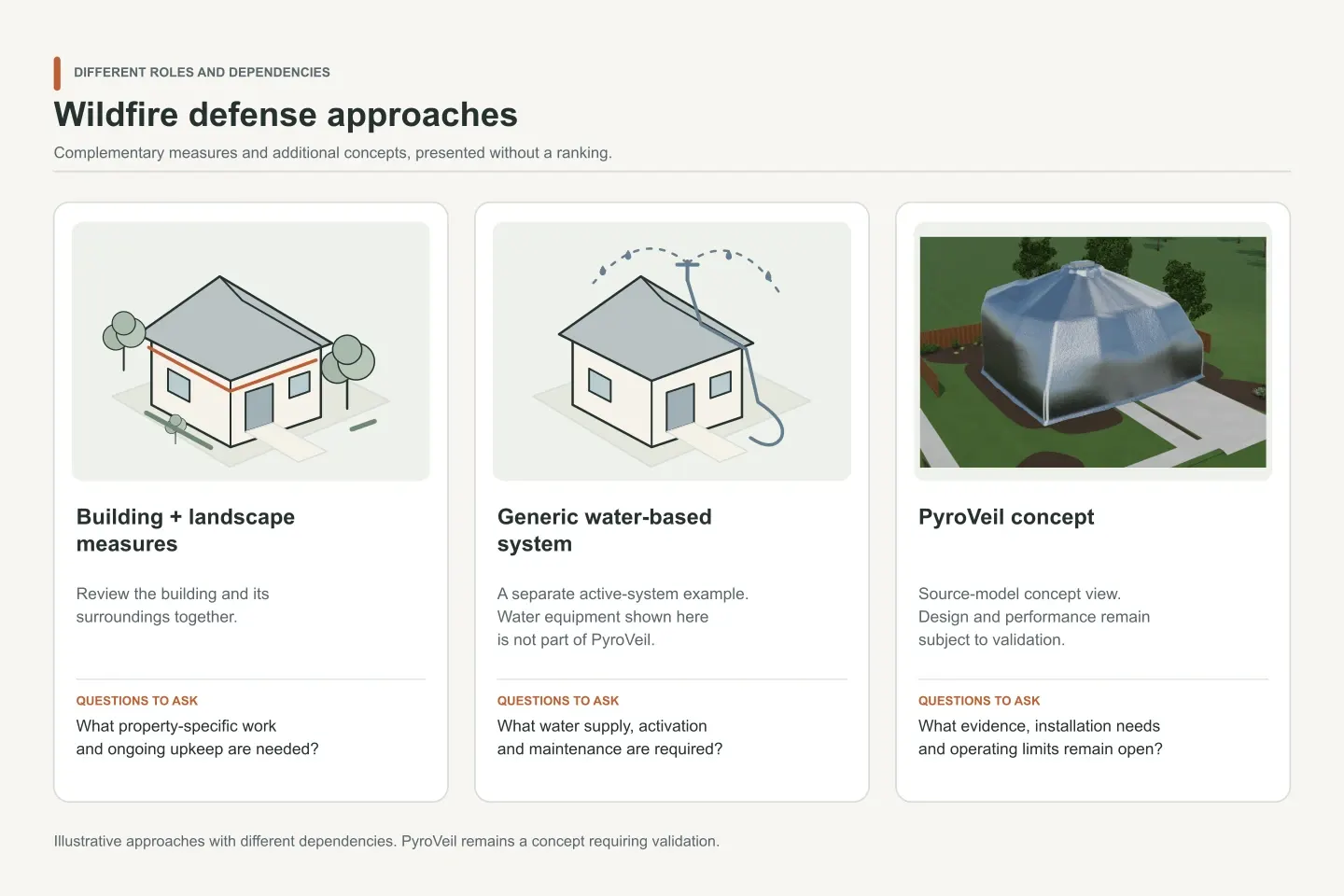
Start with improvements to the home and property
A useful comparison starts with the work already available to homeowners. CAL FIRE's home hardening guidance covers building features, while its defensible space guidance covers nearby fuels and vegetation. Our guide to home hardening and defensible space explains how to plan both.
When considering an additional system, write down the job you expect it to do. Addressing one vent, applying a coating and covering the exterior are different goals. A supplier should explain the specific problem its product addresses and provide evidence for that claim.
Questions for each approach
Exterior sprinklers
Ask for the required water flow, pressure and operating duration. Which areas were reached in testing? What happens in wind or if the water or power supply stops? Confirm how activation works, who inspects the equipment, and what maintenance is needed between uses.
Gels and retardants
Request information for the exact product and application method. Who applies it, how much is required, and how long before a possible exposure? Ask about drying, rain, material compatibility, cleanup and the conditions under which its performance was measured.
Manual structure wraps
Ask who would install the wrap, how much time and equipment the property requires, and how openings, projections and the perimeter would be handled. Establish when any preparation work must stop so everyone can evacuate safely.
Shutters, vent closures and detection
Confirm exactly which openings or events the system addresses. Ask how it is triggered and powered, how occupants receive alerts, and what happens during a communications failure. Include normal building ventilation and exit access in the installation discussion.
Compare a complete proposal
Bring the same questions to every supplier: installation cost, evidence, required utilities, upkeep, reset or replacement, and the limits of the stated coverage. Keep written answers so an impressive demonstration does not become the only basis for a purchase. Our system evaluation guide provides a fuller question list.
Where PyroVeil fits
PyroVeil is developing a rooftop stored blanket intended to deploy around a detached home after evacuation. The design goal is deployment without a water supply or household grid connection; battery and control support remain part of the concept. Those capabilities require physical validation, and the product is not commercially available yet.
Any property plan should preserve timely evacuation. Use the U.S. Fire Administration's evacuation guidance alongside local instructions.